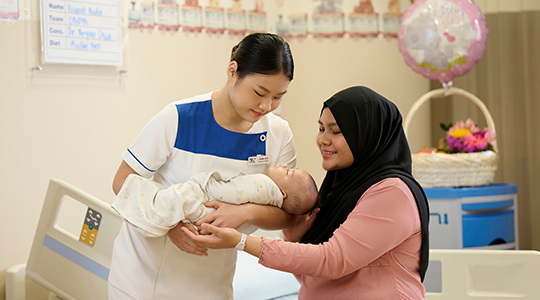

Make a lasting difference. As Singapore’s most established nursing programme, NYP’s Diploma in Nursing offers a comprehensive learning experience to prepare you for a fulfilling career in this noble profession. In addition to learning to manage medical conditions across all ages, you'll be trained to make critical decisions that can profoundly impact lives.
 Ideal applicant
Applicants should demonstrate:
- Passion in caring for others, especially in pursuing a career in the nursing industry;
- Relevant experience in a school environment or an external context (e.g. through a healthcare-related CCA, Applied Learning Module (ApLM, formerly known as Advanced Elective Modules [AEM]), competition or community outreach involvement);
- Relevant learning journeys or
- General knowledge and interest in the healthcare industry; and,
- Problem solving, teamwork, critical thinking and communication skills, guided by strong personal ethics and integrity.
 Shortlisted applicants will be assessed as follows:
Interview
If you are shortlisted, you will be invited for an interview to share more about your passion for the course with a panel of interviewers. You will be assessed on your interest, aptitude, as well as your achievements in both healthcare and non-healthcare domains. The duration of the group interview will be about 25 minutes.
Some questions which you may be asked during the interview include:
- What are your reasons for choosing the Diploma in Nursing?
- How did you realise that nursing is a career suited for you?
- Have you taken part in any nursing/healthcare related activity and how was your experience?
- Have you won any awards or taken part in any competition that is related to nursing/ healthcare?
- What are some of the special skills or talents that you possess and how do you think they may help you in this course?
Portfolio (Optional)
You should include in your portfolio, any evidence and/or activities (e.g. healthcare related or first-aid / nursing competitions) that showcase your ability and passion.
Example of what to include in your portfolio:
- Testimonials
- Certificates (e.g. academic, achievement and/or personal development)
- Awards or participation in competitions, both at school and/or national level
- Evidence of healthcare related projects or attachments
- Relevant learning journeys or ApLM
- Evidence of leadership activities or roles
- Participation in CCAs
Notes:
- Course has a course-level intake allowance of 50%.
- As the delivery of direct patient care is a requisite of healthcare professions, all applicants to pre-registration/ pre-enrolment nursing programmes must pass a medical examination and be certified to have the following abilities to perform patient care activities in a safe and effective manner:
- Mental-cognitive ability (ncluding interpersonal-communication ability and behavioural stability) to:
- understand and respond to verbal communications accurately, appropriately and in a timely manner
- possess awareness of one's surroundings to avoid causing harm to oneself and others
- demonstrate emotional stability to function under stress and pressure when performing care on patients
- remain calm when being observed by instructors and other health care personnel during clinical practice attachments
- maintain a sufficient level of concentration to complete tasks in a safe and reasonable time frame
- recall relevant information
- demonstrate the ability to perform arithmetic calculations
- Physical ability to:
- move around in the clinical environment, walk, stand, bend, squat, kneel, reach, lift, climb, push and pull, carry objects, use both arms
- perform patient transfers
- operate and carry instruments, materials and equipment independently
- perform the necessary sequences of hand-eye coordination to carry out clinical procedures
- have the physical stamina to complete clinical shifts, including rotating shifts
- Auditory ability to:
- detect faint body sounds (e.g. blood pressure, heart, bowel, lung sounds using a stethoscope)
- hear different types of auditory alarms and alerts (e.g. patient monitors, call bells, infusion pumps)
- hear and understand normal speaking level sounds in both quiet and noisy environments (e.g. person-to-person report, patient conversations, team communications)
- Visual ability to:
- detect changes in physical appearance, colour and contour
- read medication/drug labels, markings on syringes, printed and written documents, coloured digital readings on medical/clinical devices and electronic health records accurately
- assess and describe colour, consistency and volume of bodily discharge and fluids
- Mental-cognitive ability (ncluding interpersonal-communication ability and behavioural stability) to:
Should applicants have conditions1 that may affect their ability to meet the mental-cognitive, physical, auditory, or visual requirements outlined above, please contact the nursing school for further information. Where applicable, the nursing school will advise or assist with regard to the necessary adjustments to support students with declared condition(s) to access the nursing programme while adhering to necessary requirements and standards.
The above required abilities are stipulated in consultation with the Ministry of Health, Ministry of Education, and nursing schools (National University of Singapore/ Singapore Institute of Technology/ Nanyang Polytechnic/ Ngee Ann Polytechnic/ Institute of Technical Education), to ensure nursing students are fit to complete all components of the nursing programme and thereafter to apply for registration/ enrolment to practise upon graduation from the nursing programme.
Please ensure you have read and understood the Fitness to Practice Advisory for Nursing Students before applying. The guidelines in the advisory and the required abilities are stipulated in consultation with Singapore Nursing Board to ensure nursing students are fit to practise when they apply for registration upon graduation from nursing programme. Interested applicants with known condition(s) or unsure if their condition(s) may affect their ability to deliver safe and effective patient care are highly encouraged to contact us for more information.
________________________________________________________________
1 ‘Physical health condition’ includes (a) chronic medical illnesses or dermatological conditions (e.g. uncontrolled epilepsy, uncontrolled asthma, active tuberculosis, uncontrolled diabetes, uncontrolled hypertension, severe eczema on hands) which if associated with an exacerbation or with organ dysfunction complications, may hinder the applicant’s ability to provide appropriate and safe clinical care, as well as (b) health conditions or its sequelae which restrict the applicant’s subsequent ability to engage in safe clinical practice.
‘Mental health conditions’ refers to a range of conditions which are diagnosed and treated by a registered psychiatrist, and which may affect the decision-making ability of the applicant and compromise the well-being and safety of his patients/clients. These could include anxiety disorders, mood disorders (e.g. depressive and bipolar disorders), psychotic disorders (e.g. schizophrenia), neurodevelopmental disorders (e.g. intellectual development disorder, autism spectrum disorder, attention deficit hyperactivity disorder), as well as addictions.
‘Other health conditions’ refers to other conditions which may compromise the ability of the applicant to assess relevant information in order to formulate a management plan for his patient/client. This may include miscellaneous conditions for example dyslexia and other learning disorders, colour blindness or other conditions compromising the function of the applicant’s visual and auditory senses.