Connected by Design: NYP and LAPP Build a Smarter Factory, Together
NYP's School of Engineering delivers a fully integrated, robot-enabled part transfer system for global manufacturer LAPP Asia Pacific, bridging dissimilar automation platforms through a single, high-speed industrial network.
In modern manufacturing, the machinery is only part of the story. The real challenge lies in connecting systems from different vendors, running different protocols, into one seamless operation. NYP's School of Engineering partnered with LAPP Asia Pacific Pte Ltd to bridge that gap, delivering a production-ready solution that works.
In a three-month industry project, NYP developed an industrial network-enabled automated part transfer system that connects dissimilar automation control architectures across multiple fieldbus protocols. The result is a production-ready solution integrating robots, actuators, and field devices under a unified, real-time automation network.
The Opportunity
Headquartered in Stuttgart, Germany, LAPP is a global leader in cable, connector, and automation technology. With 5,700 employees across 27 manufacturing sites and a presence in over 80 countries, the family-owned company delivers the integrated and customised robotics solutions that power modern industry worldwide.
As part of expanding its digital factory capabilities, LAPP Asia Pacific recently designed a unified network to coordinate electrical actuators, an industrial robot, and field devices with third-party platforms in real time.
The primary requirement was achieving seamless synchronisation at machine speed. Because the project involved two distinct control systems with separate communication standards, hardware alone wasn't enough. To design a reliable, multi-protocol architecture that could bridge this gap, LAPP collaborated with NYP to co-develop the core automation infrastructure.
The Solution
NYP's engineering team, led by Senior Lecturer Mr Jackson Ng, developed a Mitsubishi Electric PLC-based control platform that interoperates with LAPP's own system across four industrial protocols:
• CC-Link IE Field/Basic for high-speed controller-to-controller communication
• IO-Link for intelligent sensor and actuator integration
• Profinet for real-time industrial Ethernet connectivity
• Modbus/TCP for compatibility with third-party and legacy field devices
NYP also programmed and integrated a third-party industrial articulated robot to handle the physical part transfer, completing the full production cycle. Two Final-Year Project (FYP) learners from the Diploma in Robotics & Mechatronics (now known as Diploma in AI Robotics), as part of their FYP requirements, helped contribute to the build under direct supervision, gaining hands-on experience on an active industry project.
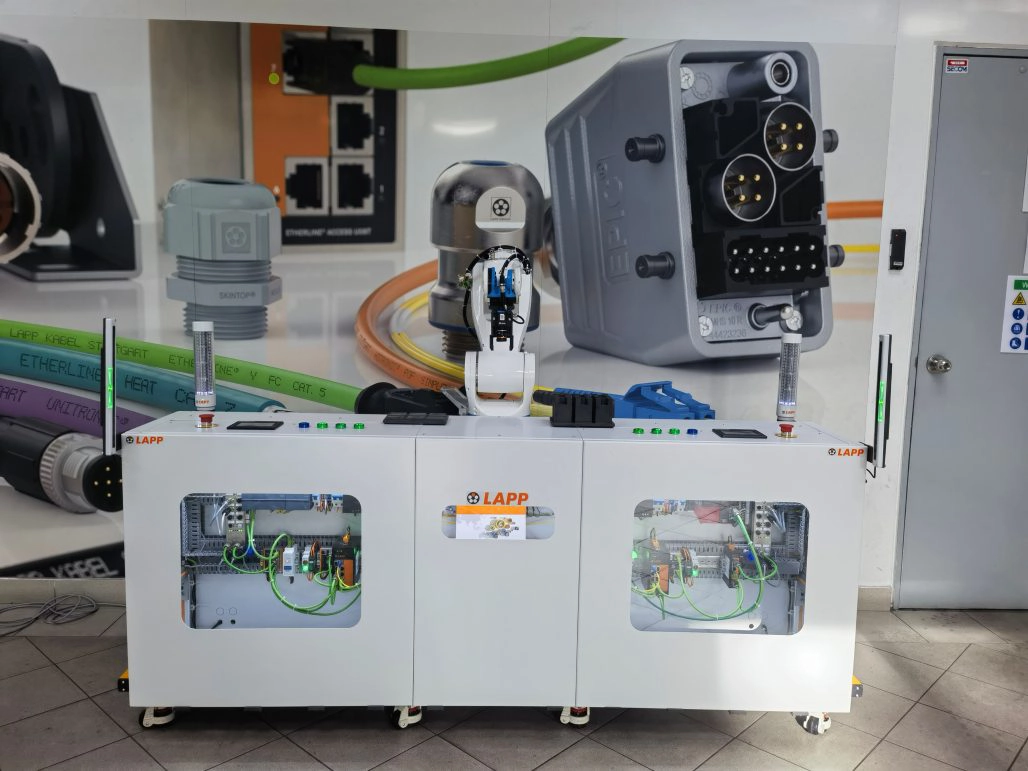
In the joint collaboration to advance digital factory optimization, LAPP APAC and NYP built a PLC-based multi-protocol automation part transfer system—uniting robotics, precision actuators, and field devices. By integrating LAPP’s high-durability cabling, connectors, and network solutions into the co-created design, the system effortlessly handles high-speed mechanical wear while delivering reliable, real-time performance.
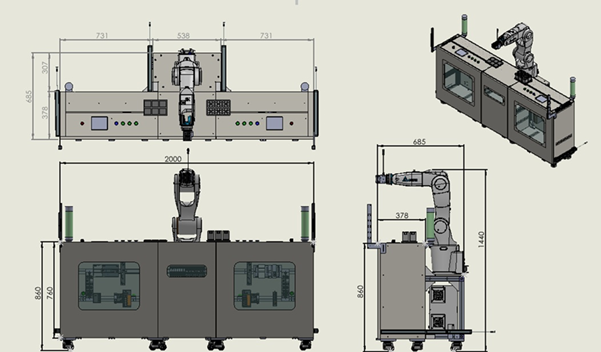
Engineering CAD modelling of the automated part transfer system.
Outcomes and Impact
This joint engineering effort successfully produced a fully integrated, open-protocol factory automation platform, achieving precise, coordinated control across the entire part transfer workflow. The collaboration delivered:
• A distributed automation solution built on high-speed industrial networking, improving system productivity
• Enhanced multi-protocol capabilities, combining LAPP’s industrial network foundation with NYP’s system integration expertise for future project deployments.
• A strengthened tripartite working relationship between NYP, LAPP, and OEM equipment partners across network design, integration, and delivery.
For NYP's School of Engineering, the project validated the team's end-to-end capability in digital factory automation, from network architecture to system commissioning.
As a multinational company and MOU partner, LAPP's decision to engage NYP on their first formal collaboration is a strong endorsement of NYP's technical competency and project management standards. This successful engagement lays a promising foundation for what comes next - broader opportunities across LAPP's partner network and new pathways for innovation and industry development between both organisations.
Marc Jarrault (LAPP APAC COO) said:
"Industry-academia collaboration is very important because there is significant growth through mutual exchange. We hope to maintain continuous interaction through additional projects."
More from our Industry Projects

From Consumer Insights to Market: NYP Supports CP Foods' Ready Meal Launch
A consumer study helped CP Foods Singapore better understand how consumers responded to three ready meal products before they were brought to market.
Connecting a New Generation with National Service Through The Call Up
NYP’s School of Business Management partnered with Nexus, MINDEF to produce a four-part video podcast series that brings National Service conversations closer to youths and families.
Serving Smarter: How NYP Brought Generative AI to the Luxury Retail Floor
NYP's Centre for Applied AI partners with The Canary Diamond Company to co-develop a Generative AI sales companion that transforms frontline retail performance, turning everyday customer interactions into measurable, organisation-wide intelligence.